
Ranking for treatment terms that do not match what the practice actually delivers
STAGE 02 OF 06 — VISIBILITY
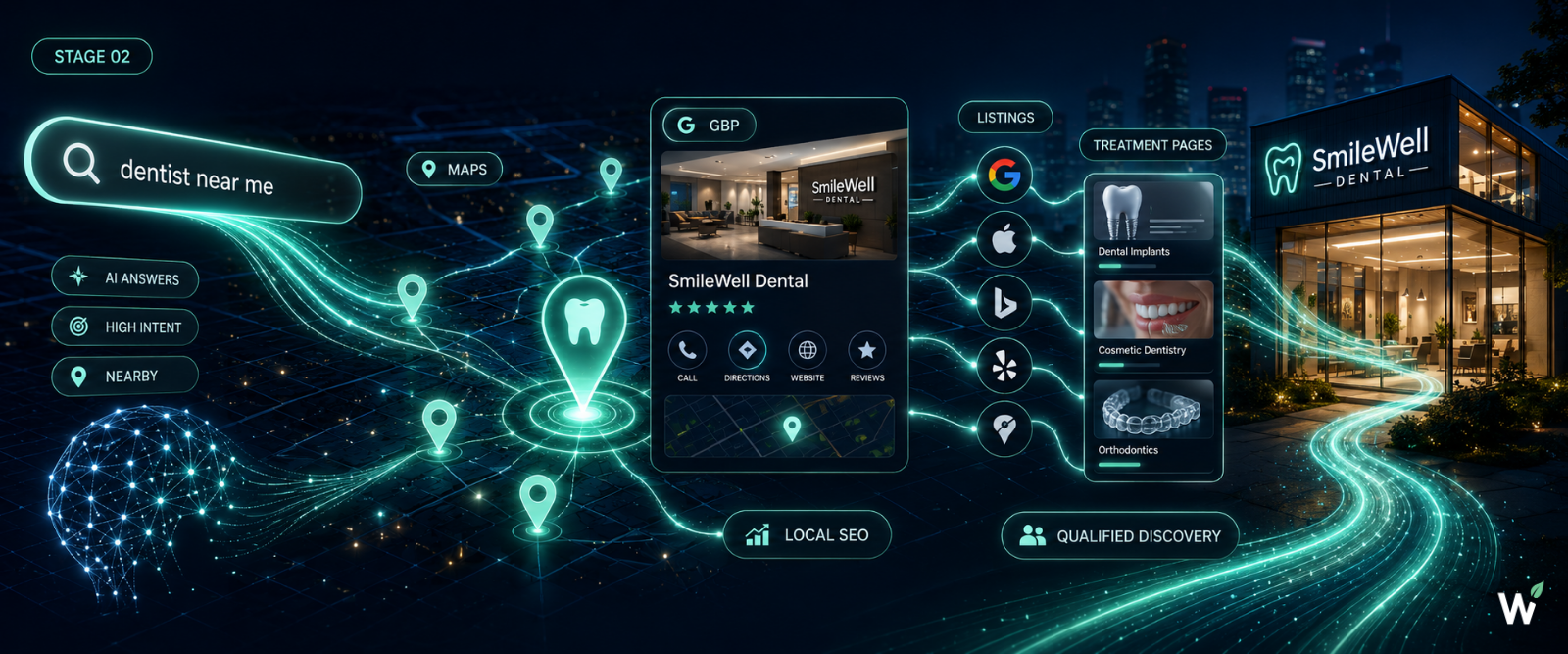
Become findable where dental patients already search.
Visibility is not about chasing traffic. It is about helping high-intent prospective patients discover your practice when they are actively searching for treatments, comparing providers, or asking for recommendations.
WHY IT COMES SECOND
Unclear foundations create unclear visibility.
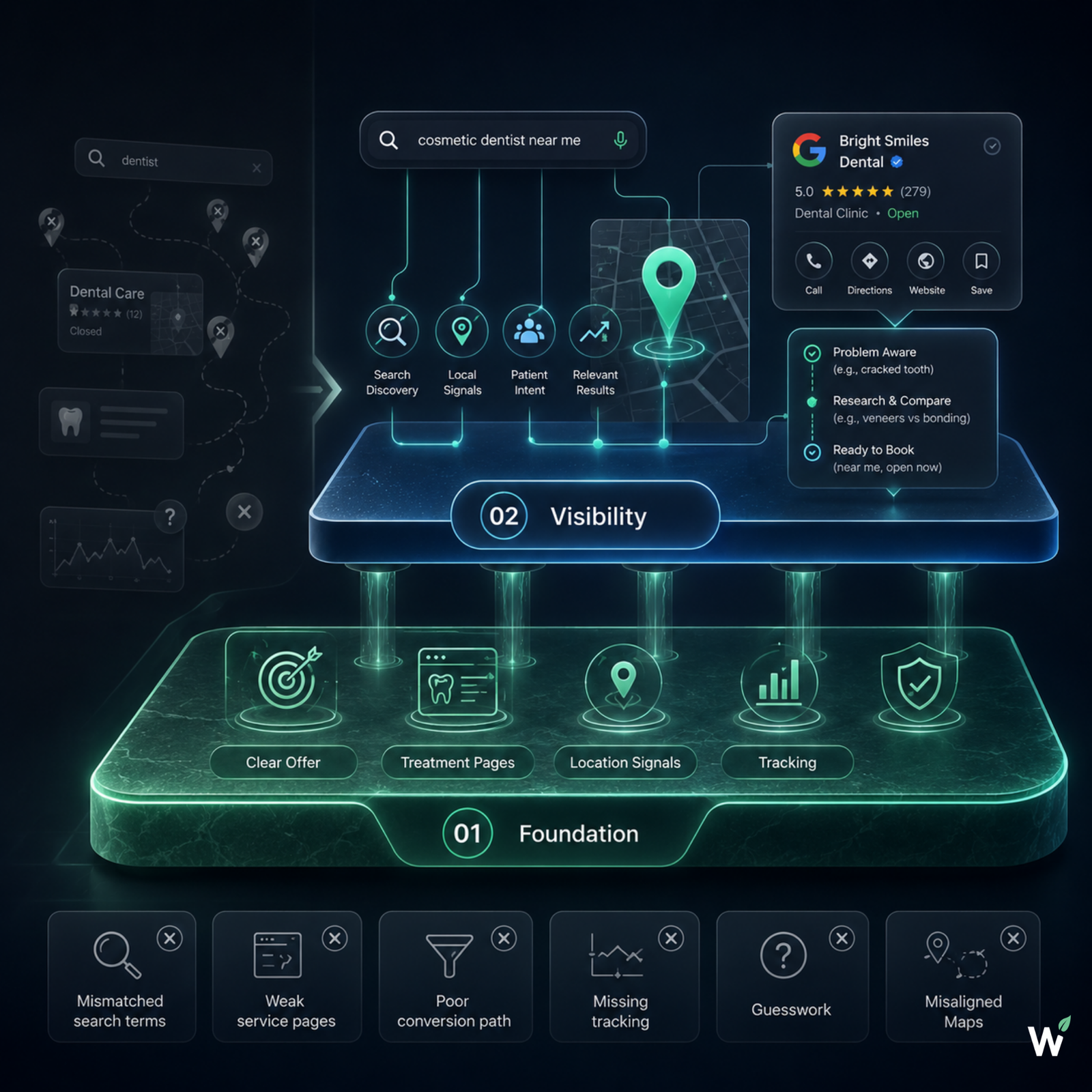
Visibility work needs something clear to make visible. If a practice’s treatment offer is unclear, if treatment pages are thin, if location signals are inconsistent, or if tracking is missing, search engines and prospective patients receive weak signals.
That is why Foundation comes first. Foundation clarifies what the practice offers, which treatments it wants to grow, where it serves patients, and how its current path is structured.
Once that baseline is clear, Visibility can focus on the right local searches, the right treatment intent, and the right discovery channels — instead of pushing patient traffic toward pages that are not ready to convert.
01
Foundation before Visibility
6
stages in the Growth System
What this prevents
Creating treatment pages around unclear or incomplete service descriptions
Sending prospective patients to weak conversion paths
Improving visibility without the tracking in place to know what changed
Treating search demand as a guessing game instead of a directed diagnostic
Improving Maps visibility without aligning GBP categories to the treatments patients are actually searching for
WHAT WE REVIEW
We build discovery around dental patient intent.
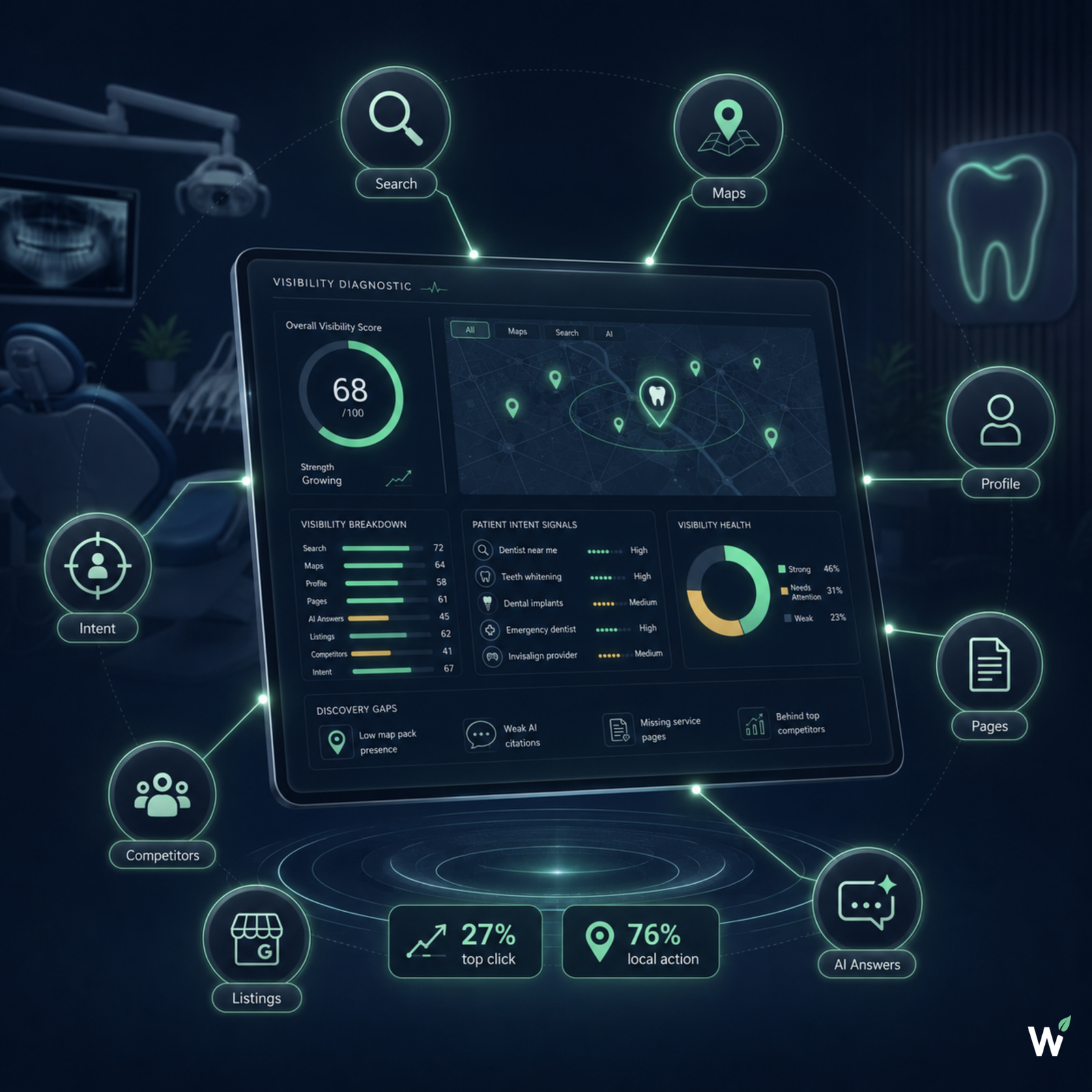
GROWSILK reviews how your practice appears across the places prospective dental patients use to begin their decision. The goal is to identify where qualified discovery is weak, where competing practices are easier to find, and what needs to be built next.
27%
of all clicks go to the #1 organic result — Backlinko
76%
of local searchers visit a practice within a day — Google consumer research
What GROWSILK reviews and builds
Local SEO
Local SEO helps your practice appear in organic results for dental treatment searches. GROWSILK reviews whether your pages, location signals, treatment language, and local content match how patients in your area actually search.
Google Maps
Google Maps is often where dental patients compare nearby practices quickly. GROWSILK reviews Maps visibility, category alignment, location signals, review presence, and how clearly your listing supports the next step.
Google Business Profile
Your Google Business Profile can be a prospective patient’s first impression. GROWSILK reviews categories, services, treatment descriptions, photos, posts, reviews, and booking actions.
Treatment page optimisation
Treatment pages need to be clear to search engines and persuasive to prospective patients. GROWSILK reviews whether each priority treatment page — implants, cosmetic dentistry, clear aligners, sleep apnea, general dentistry — has sufficient clarity, location relevance, patient intent alignment, and next-step direction.
AEO and GEO readiness
Dental patients increasingly ask AI tools for recommendations. GROWSILK reviews whether your content answers patient questions clearly enough for answer engines and generative tools to understand and cite your practice.
Listings management
Inconsistent listings create weak signals and patient confusion. GROWSILK reviews practice name, address, phone, categories, descriptions, and presence across key dental and local directories.
Competitor visibility snapshot
Competitor visibility shows what prospective patients see before they reach you. GROWSILK reviews which practices appear first, where they appear stronger, and what visibility gaps should be addressed first.
Content and patient intent alignment
Whether treatment page content matches the actual decision-stage questions dental patients ask — covering cost, candidacy, process, alternatives, and expected outcomes — so search engines and patients receive the same clear signal.
Deliverable framing
- The result is not a generic traffic plan. It is a clearer view of where your practice’s discovery layer is weak and what needs to be built to attract qualified, high-intent patient demand.
QUALIFIED DISCOVERY
Not all visibility turns into patients.
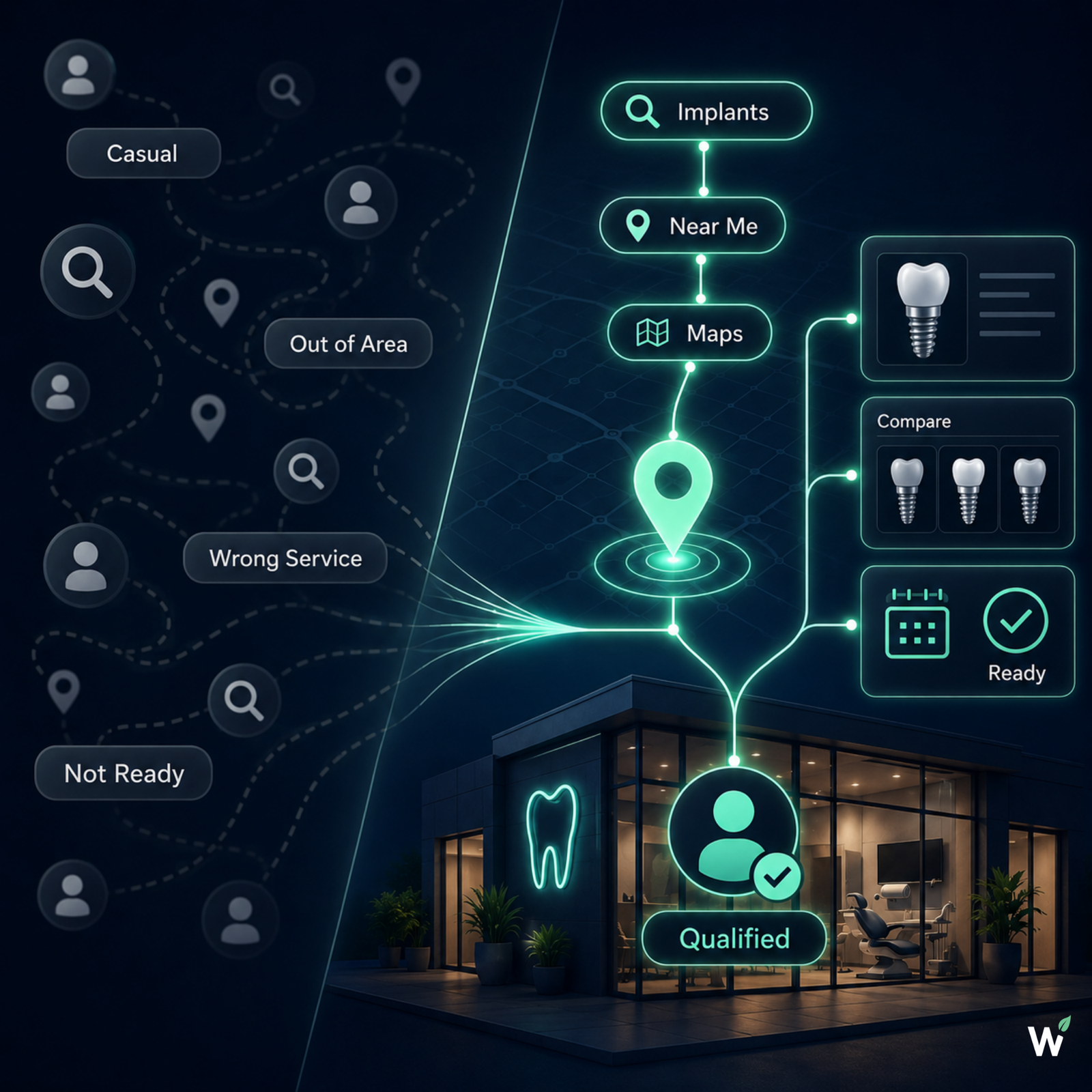
A dental practice can rank and still attract the wrong visitors. It can get traffic from people who are researching casually, outside the service area, looking for a different treatment, or not ready to enquire.
Qualified discovery means being found by prospective patients with treatment intent. They have a specific need, a specific treatment in mind, a location preference, and a reason to compare dental providers now.
That is the difference between appearing online and being commercially findable as a dental practice. Qualified discovery looks like: patients searching for your priority treatments by name, local searches tied to your service area, Google Maps views from nearby prospective patients, and content that answers decision-stage questions.
Practice owner language this stage resolves
We get website traffic, but not the right patients.
People search for dental implants and our competitors appear first.
We are visible for general dentistry but not for the treatments we want to grow.
Our treatment pages are not showing up when patients search.
NEXT STAGE
Being visible is only the beginning.
Visibility gets your practice into a prospective patient’s consideration set. But once patients find you, they still need to trust what they see.
That is why the next stage is Trust. Reviews, before-and-after proof, authority content, credibility signals, and clinical differentiation help turn discovered visitors into confident patients who move forward.
Without Trust, visibility can create attention that still leaks.
START WITH DIAGNOSIS
Find out if Visibility is where your practice is leaking.
The Dental Growth Score helps identify whether your biggest bottleneck is Visibility, Trust, Conversion, or multiple leaks across your practice’s growth path.
Visibility Stage
Trust
Conversion
Retain & Grow
Find out where your dental practice’s growth path is leaking.